
Peru is fast turning
into a capital of the pyramid world having the oldest officially recorded
pyramid in the world. Purgatorio as it is named by the locals refers to the
numerous pre Hispanic pyramids, mounds and enclosures located on the
surrounding plan of La Raya Mountain and south of the La Leche River and the
Lambayeque valley, boats many natural and manmade water ways. Besides, this region also has a large number
of pyramids. Towards the city of Sipan, is a major pyramid concentration of
South America, the pyramids of Tucume and is known as the Pyramids of the
Valley of the Pyramids. The Lambayeque Valley, the largest valley along the
North Coast of Peru is located between the Pacific Ocean and the Andes Mountain
range and has no less than three pyramid cities when combined have an amazing
number of around 250 pyramids. These
three cities are understood to be built after a city was abandoned and a new
one built in succession of each other. The first city known as the Pampa Grande was
built somewhere between 600 and 750 AD, and the pyramids were known as Huaca
Fortaleza which were built amounting to a height of fifty meters and 200 meters
wide. This structure does not seem to be very impressive in spite of it being
intact. The other is the Batan Grande, built between 750 and 1100 AD; with 34
pyramids inclusive of the Huaca de Oro also known as the Pyramid of Gold,
before which a series of royal tombs were located. These pyramids are ruined
due to El Nino rains in the year 1982 and 1998 though the major destruction was
man made in 1100 AD when the pyramids were burnt and the town was abandoned to
be taken over by Tucume between 1100 and 1500 AD.
The Tucume site with
an area of over 540 acres of land encompasses around 26 major pyramids and
platforms and is a part of the Lambayeque Valley pyramids inperu which is the largest valley of
the North Coast of Peru. Tucume lies on the southern side of the valley and due
to the Taymi irrigation canal which runs over 43 miles long, is able to provide
water northwards from Chancay River and is surrounded by rich agricultural
fertile land. The locals believed that the gods lived within these structures
and continue to invoke its power and the gods who once lived within these
structures. Various legends regarding
this city are recorded and one such legend recorded by Father Cabello de Balboa
in 158 states, how Cala, a grandson of Naylap, the founder of the Lambayeque
royal dynasty declared Tucume as the new metropolis for the people and that
Cala was exiled from Batan Grande.

The Greeks Parthenon after recovering from
the war with the Persian, in 480 BC, rebuilt the city of Athens and erected a
sanctuary on the Athenian Acropolis, Greece, which was a beautiful temple,
dedicated to the maiden goddess Athena and whom they considered as their patron
deity. The Parthenon by which the temple was called was designed by two
architects, Iktinos and Kallikrates and was built with fine white Pentelic
marble. In the shrine was placed an image of the goddess which was 40 feet (12
m) and was sculptured by Phidias in gold and ivory. Athena as the warrior
maiden is a combination of male and female, beauty and strength representing
Athens. Athena is looked upon as the protector and champion of the city. The
goddess is seen holding a Nike figure of winged victory in her right hand to
commemorate the victory over the Persians. The helmet, worn by her bears the
resemblance of the image sphinx in the center and griffin on the either side. In
the center on the upper chest of Athena is an aegis on which is a gorgoneion -
head of Medusa which plays the role of warding off evil. The snake that appears
on the inner side of her shield is referred to a mythical origin of Athens
The Parthenon a
Doric temple has eight columns at the façade and seventeen columns at the
flank. This construction cost the Athenian treasury, 469 silver talents and
while it is difficult to create an equivalent amount, one talent was the cost
to build trireme, one of the most advanced warship of that era. This unique Greek temple’s construction started in
447 BC and though the decoration of the temple continued till 432 BC; it was
finally completed in 438 BC. All the temples in Greece were designed to be seen
from the exterior and the viewers could only glimpse the interior statues through
the open door and never entered the temple. It was perceived in a way that the
aesthetic elements permit a smooth transition of the exterior and the interior
which housed the statue of the maiden goddess. It is considered as one of the
most enduring symbol of Ancient Greece and the world’s greatest cultural
monument. The Greek Ministry of Culture is presently planning a program of
restoration and reconstruction for the stability of this partially ruined
structure. The Greek Parthenon which
has replaced an older temper of Athena that was destroyed by the Persian
invasion is archaeoastronomically linked to Hyades and like most Greek temples
was used as treasury. For some time it even used as a treasury for Delian
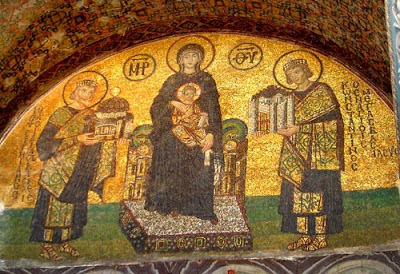
League and later for the Athenian Empire. Towards the 5th century AD: it was
converted into a Christian Church which was dedicated to the Virgin Mary
When the Hebrews
left the land of Egypt, it was then that Moses received instructions from God
on the building of the Ark. The instructions laid down was that it should be
made of acacia wood of two and a half cubit long, a cubit and a half wide and s
cubit and a half high. It had to be
overlaid both inside as well as outside with pure gold with a gold moulding
around it. Cast of four gold rings for
it was fasten to its four feet, two on either side of it. Poles made of acacia
wood overlaid with gold were inserted into the rings to enable them to carry
the chest. The atonement cover was made of gold, two and a half cubit long and
a cubit and a half wide with two cherubim out of hammered gold at the end of
the cover. These were made of one piece and placed on each side facing the
cover with their wings spread upwards overshadowing the cover. Instructions
were given not to remove the poles but to leave them in the rings of the ark.
The Ark according to the Scriptures was supposed to be carried only by Levities
which were a group of Hebrews who were set aside for the purpose of temple
service. The history mystery of The
Ark of the Covenant also called the Ark of God is very intriguing and
mysterious which started in the Bible in Exodus Chapter 25:10.

The Bible states
that it was in the Ark of the Covenant from where God spoke to Moses and his
people, the Israelites. There is a lot of speculation and history mystery about the acacia wood though some consider it to be
cedar wood. It is said that while Moses
and his people camped during their flight from Egypt, the Ark of the Covenant
was stored in a section they had constructed in the travelling tabernacle known
as the `Holy of Holies’, It was here that God would talk with Moses and the
Priest and receive instructions from God. It is believed that inside the chest
lie the remains of the original tablet of the Ten Commands and some of the
Israelites sacred relics. When the Israelites settled in the Promised Land, a
permanent temple to God was prepared by Kind David. While the Ark had to be
carried by the Priest, as per God’s instructions, manhandling of the Ark was
considered to be dangerous though it was also responsible for many miracles for
the Israelites in times of need. At the time of battle, whenever the ark was
carried, at God/s command, the Israelites experienced victory. The amazing history mystery of the Ark of the Covenant is beyond the
understanding of human minds since it originated under God instruction to His
prophet Moses.
